
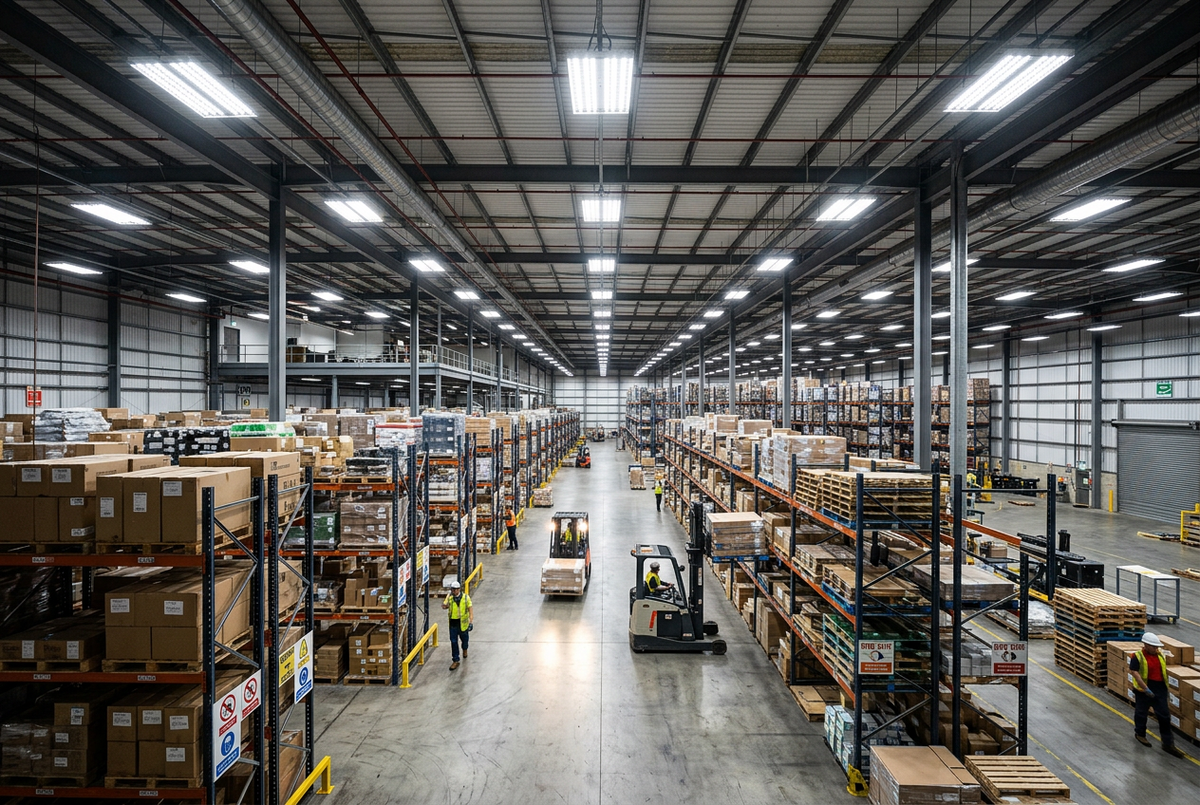
Warehouse lighting has to do more than fill a tall room with light. It has to make aisles readable, keep rack labels clear, support safe movement, and do all of that without turning the electric bill into a second rent payment. An LED high bay light for warehouse use is built for that job. These are large overhead commercial fixtures made for high ceilings, stockrooms, and storage areas. The right choice in 2026 starts with the building and the work below, not with the lowest wattage on a spec sheet.
This guide covers mounting height, lumen output, beam distribution, color temperature, certification, and long-term service. It also explains where a compact UFO high bay fits and what to verify before placing an order.
What an LED high bay light does in a warehouse
High bay fixtures combine a high bay housing with LED light engines. Compared with older high bay lighting, LED fixtures are more energy efficient, safer, brighter, and longer lasting. That combination matters in warehouses because lights run for long shifts, sit far above the floor, and are expensive to reach for service.
LED high bays are used in warehouses, stockrooms, storage facilities, gyms, barns, garages, and other commercial or industrial settings with high ceilings. A fixture mounted well above the work surface needs to push light downward with enough intensity and spread to reach people, equipment, and labels without dark pockets between rows.
Start with ceiling height and mounting layout
Ceiling height is the first practical filter. A high bay is designed for high ceilings. Before comparing products, note the mounting height, the underside of the roof deck or truss, sprinkler lines, heat sources, and any obstructions that could block light. In a racked warehouse, aisle width and rack height also affect how light should be distributed.
Layout matters as much as the fixture. Two warehouses with the same square footage can need different fixture counts if one has tall racking and narrow aisles and the other has open floor and low storage. Use a lighting layout or photometric plan when possible. The goal is even coverage at the work plane, not a bright spot directly under each fixture. A supplier that can review mounting height and layout details is more useful than a product page that lists wattage alone.
Match lumen output to the work below
Lumens measure light output. Wattage measures power use. They are related, but they are not the same thing. For warehouse planning, start with the lumens needed at the floor and rack faces, then compare the lumens per watt of each fixture. A higher lumen output can mean fewer fixtures, but only if the light is distributed where it is needed.
One useful benchmark is a 200W UFO high bay that produces 30,000 lumens at 150 lumens per watt and 5000K. That gives buyers a concrete reference point. A 200W fixture is not automatically equal to another 200W fixture. One may deliver 30,000 lumens while another delivers less, and the difference changes fixture count and layout. Ask for lumen output, lumens per watt, and photometric data for the exact model under consideration.
Choose beam distribution and reflector style
Beam distribution describes how the fixture spreads light. Some high bay fixtures use aluminum or prismatic reflectors to create broad light distribution. That broad spread can help fill aisles and reduce harsh hot spots under the fixture. The right distribution depends on ceiling height, rack arrangement, and whether the space needs general ambient light or more focused light down long aisles.
A narrow distribution can be useful in some layouts, while a wider distribution can reduce the number of fixtures in others. The fixture alone does not tell the full story. Check the manufacturer's photometric files and layout guidance. If a supplier offers reflectors as an option, confirm which reflector matches the planned mounting height and aisle pattern.
Color temperature and visual comfort
Color temperature affects how the space looks and how quickly people can read labels, packaging, and safety markings. The 200W UFO example is 5000K, a cool-white option for industrial spaces. Cool white can look crisp in a warehouse, but the best choice depends on the tasks, the existing lighting, and the preferences of the people working under it.
Consistency also matters. Mixing widely different color temperatures in one space can make the lighting look uneven and can distract from rack labels and floor markings. If the project adds fixtures to an existing system, compare the new fixtures with the current color temperature. If the project is a full replacement, choose one color temperature and apply it across the layout.
UFO high bay lights for warehouse ceilings
UFO high bay lights are compact, round fixtures built for high-ceiling warehouses and facilities. They are described as durable and energy efficient, with the ability to meet the lighting needs of many warehouses and facilities with high ceilings. Their shape and mounting style can suit open ceiling structures where a compact fixture is preferred.
UFO models are not the only high bay shape, but they are a common option for warehouse projects. Check the same fundamentals: lumen output, efficiency, beam distribution, color temperature, and certification. A compact UFO fixture still needs to fit the mounting height and the layout. Treat the shape as a form factor, not a guarantee of performance.
Certification and food-safe storage
Some high bay fixtures are NSF Certified and described as food safe for warehouses, stockrooms, and storage facilities. That certification can matter in food storage, packaging areas, or other spaces where fixtures must meet cleanliness expectations. Not every warehouse needs an NSF-certified fixture, but a food-related facility should check the requirement before ordering.
Ask for the specific certification on the model you plan to buy. A general product category page may mention food-safe options, but the certification should apply to the exact fixture. Keep the certificate or listing with the project documents so facility managers and inspectors can review it later.
Efficiency, safety, and long-term service
LED high bays are more energy efficient than older high bay technologies, and they are also described as safer, brighter, and longer lasting. For a warehouse, those benefits show up in two places: the utility bill and the maintenance schedule. Long-life fixtures reduce the labor and disruption that come with replacing lamps in a high ceiling.
Efficiency should be compared at the fixture level. Use lumens per watt to compare models, then factor in the layout. A fixture with high lumens per watt may still be the wrong choice if its beam pattern leaves dark aisles. The best plan balances output, distribution, and service access. Contractors and facility managers can also ask about bulk or contractor pricing, since warehouse projects often involve quantities that qualify for quantity discounts.
A practical 2026 selection checklist
|
Selection factor |
What to verify |
|
Mounting height |
Confirm the fixture is intended for high ceilings and fits the structure and obstructions. |
|
Lumen output |
Compare lumens at the exact model level. Use the 200W, 30,000-lumen UFO example as a benchmark, not a universal rule. |
|
Efficiency |
Check lumens per watt. The example model is rated at 150 lumens per watt. |
|
Beam distribution |
Review reflector options and photometric data for aisles, racking, and open floor. |
|
Color temperature |
Choose a consistent CCT. The example UFO is 5000K. |
|
Certification |
Confirm NSF certification when food-safe storage requirements apply. |
|
Service and support |
Ask about warranty coverage, quantity pricing, and layout help before ordering. |
Use the checklist as a conversation guide with the supplier. A fixture that passes every line item is more likely to perform as planned than one chosen on wattage or price alone.
How Greenervolts fits a warehouse lighting project
Greenervolts LED Store sells commercial and industrial LED lighting fixtures and electrical supplies, including high bay options for warehouses and industrial spaces. The store is Maryland-based and positions itself around energy efficiency, utility rebate savings through the MD EmPOWER program, and warranty-backed products for business buyers. For a Maryland warehouse project, ask about current rebate documentation and the 5-year warranty before finalizing the fixture list.
Warehouse lighting is a long-term purchase. The fixtures you choose in 2026 should still make sense after the first utility bill, the first maintenance cycle, and the first layout change. Start with the ceiling, the work below, and the light distribution. Then compare lumen output, efficiency, certification, and support.
Frequently Asked Questions
How many lumens do I need for a warehouse high bay?
There is no single lumen number for every warehouse. Mounting height, rack height, aisle width, task detail, and the desired light level all affect the answer. Use a photometric layout for the exact fixture. As a reference, a 200W UFO high bay can be rated at 30,000 lumens and 150 lumens per watt.
Are UFO high bay lights good for warehouses?
UFO high bay lights are durable and energy efficient, and they can meet the lighting needs of many warehouses and facilities with high ceilings. They are a form factor, not a guarantee. Check lumen output, beam distribution, color temperature, and certification for the exact model and layout.
What color temperature should a warehouse high bay use?
There is no universal color temperature. The 200W UFO example is 5000K, a cool-white choice for industrial spaces. Match the color temperature to the tasks and the existing lighting, and keep it consistent across the layout. Verify the CCT on the exact model before ordering.
Do warehouse high bay lights need NSF certification?
Not every warehouse needs NSF certification. It matters in food-safe storage, stockrooms, and facilities with cleanliness requirements. Some high bay fixtures are NSF Certified and food safe. If your facility handles food or requires food-safe equipment, confirm that the exact fixture carries the certification.
What should I compare besides wattage?
Compare lumens, lumens per watt, beam distribution, reflector type, color temperature, certification, and supplier support. A 200W fixture can vary in output, and the layout determines whether the light reaches aisles and rack faces. Ask for photometric data and confirm warranty and quantity pricing before buying.
Share:
Parking Lot Pole Lights: A 2026 Buyer's Guide for Maryland Properties