
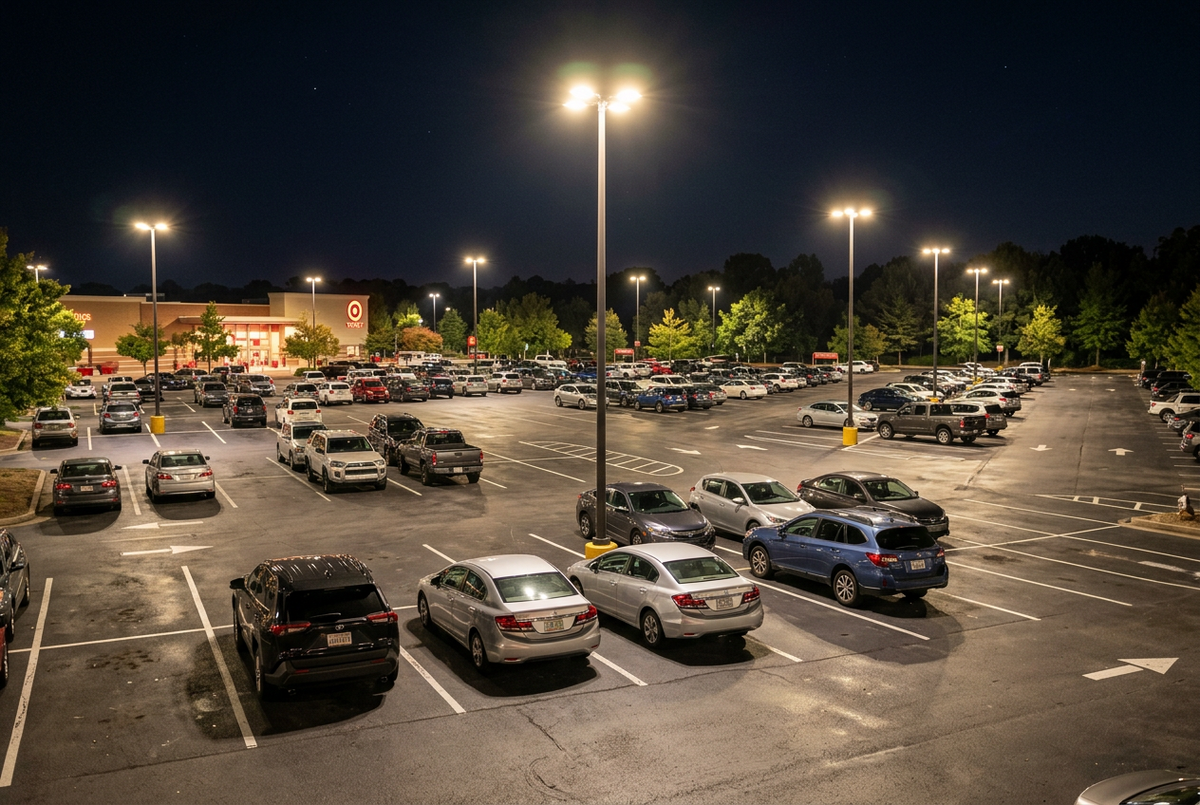
A parking lot lit by aging heads on tall poles is one of the easiest places for a facility manager to find savings. The poles are already standing, the circuits are already run, and the fixtures burn for hours every night whether anyone is shopping, parking, or loading a truck. Replacing the heads, or buying a complete pole kit for a new lot, changes both the monthly utility bill and the maintenance calendar. This guide breaks down what actually drives the cost of parking lot pole lighting in 2026, which specifications matter, and how to compare quotes without getting buried in line items.
Why Pole Lighting Is Usually the First Place to Look
Parking lot pole lights are tall, outdoor-rated structures designed to support area lights and deliver broad illumination across a commercial parking area. That combination of height and long nightly run times means the fixtures do the most work of any exterior lighting on a property and consume the most electricity.
The shift to LED pays off on several fronts at once. LED parking lot pole lights offer superior energy efficiency compared with legacy sources, long-term cost savings, better color rendering, and a range of color temperatures to choose from. Better color rendering matters more than it sounds in a parking lot, because drivers and pedestrians judge faces, curbs, and painted lines under whatever light the fixture produces.
The Cost Drivers That Shape a 2026 Budget
There is no single sticker price for parking lot pole lighting. Cost is built from a stack of decisions, and each one moves the number. The table below shows the drivers that appear in nearly every quote.
|
Cost driver |
What changes |
Effect on budget |
|
Pole height |
Kits are available with pole heights from 10 to 30 feet |
Taller poles use more material and heavier hardware |
|
Fixtures per pole |
Two lights per pole is the standard arrangement |
Doubles the fixture and bracket count |
|
Wattage and lumens |
Selectable-wattage heads let one fixture cover several output levels |
Higher output raises power draw and heat load |
|
Controls |
Photocells and dusk-to-dawn sensors |
Small hardware addition, large run-hour reduction |
|
Pole style |
Functional or decorative shafts and brackets |
Decorative designs carry a premium |
|
Installation |
Site access, base work, and electrical connections |
Varies widely by site conditions |
Pole Height and How Much Light It Delivers
Height is the first decision because it governs everything downstream: how wide the pool of light spreads, how far apart poles can be spaced, and how much wattage each fixture needs to reach the pavement.
Fixed LED parking lot light pole kits come with selectable wattage and pole heights running from 10 to 30 feet, which covers most commercial layouts. For smaller parking areas and residential-style applications, 15 to 20 foot poles pair well with bulbs in the 12,000 to 18,000 lumen range. Above that height, output has to climb to keep the same light level at ground level.
How Many Fixtures Belong on Each Pole
Two lights per pole is the standard configuration for commercial lots. A single-head pole works for a corner, a walkway edge, or an island where light only needs to travel in one direction. Four-head poles exist but are uncommon outside large distribution lots, because each added head multiplies both the fixture cost and the load on the pole structure.
Wattage, Lumens, and Color Temperature
Selectable-wattage fixtures are worth asking for. One fixture family that can be set at several output levels reduces the number of SKUs a contractor has to carry and lets a property owner adjust if the layout is revised later. Color temperature should be chosen once and specified consistently across the lot, since mixing color temperatures across poles makes a property look patchy at night even when the light levels are correct.
What Is Actually in a Pole Lighting Assembly
Buying a complete kit rather than loose components saves a lot of coordination. A typical fixed LED pole kit bundles the pole, the mounting bracket or brackets, and the area light head or heads.
- Pole and base plate. Built for strength, safety, and stability, and sized to carry the fixture load at the specified height.
- Brackets. Available in single and double configurations to match the fixture count.
- Area light head. Also called a shoebox fixture in parking lot applications, or a post top and acorn lantern for decorative layouts.
- Controls. A photocell or smart dusk-to-dawn sensor so the fixtures run only after dark.
Decorative options are not limited to lanterns. Buyers can choose from functional and decorative parking lot light poles, street light poles, and brackets to hit a specific design intent, which is useful for mixed-use properties that need the lot to match the building.
Where the Utility Savings Come From
Three levers do most of the work on a pole lighting retrofit or a new install.
- Lower power draw. LED heads convert more of the electricity they consume into visible light, so a comparable light level costs less to produce every night.
- Fewer burning hours. A dusk-to-dawn photocell keeps fixtures off during daylight and on only when needed, which removes the human error of a manual timer drifting with the seasons.
- Less maintenance labor. Long LED service life means fewer bucket truck visits, fewer lamps, and fewer ballast replacements. On a tall pole, the labor to change a head can rival the cost of the head itself.
A fixture with an IP65 rating and ETL listing is a reasonable baseline for outdoor pole mounting, since it signals the housing is sealed against weather and the product has been tested to a recognized safety standard. Specifications like these show up in commercial 240W pole-mount heads rated at 60,000 lumens and 5000K with smart dusk-to-dawn photocells, which is the kind of package most lots need.
Maryland Rebates and Utility Incentives
For properties in Maryland, the economics improve further through the MD EmPOWER program. Greenervolts is a Maryland-based preferred member of five utilities and passes MD EmPOWER rebate savings directly to customers, so the incentive is applied to the purchase rather than chased down later as a mail-in claim. Program rules, eligible equipment, and incentive amounts are set by the utilities and can change, so confirm current terms with your utility or with the supplier before finalizing a budget.
How to Compare Two Pole Lighting Quotes Fairly
Quotes for the same lot can differ by a wide margin and still both be correct, because they may describe different scopes. Put every bid on the same footing before choosing.
- Confirm the pole height and whether the price covers the pole, the base plate, and the brackets or only the fixture head.
- Confirm the number of heads per pole.
- Confirm whether wattage is fixed or selectable.
- Check the color temperature and whether it is consistent across the whole lot.
- Ask whether photocells or other controls are included.
- Check the IP rating and the safety listing.
- Ask about the warranty period and what it covers.
- Separate equipment cost from installation cost so you can see where the money actually goes.
Building the Budget Step by Step
A pole lighting budget comes together in a predictable order. Walk the lot and note the existing pole locations and heights, then decide whether poles are being reused or replaced. Choose the fixture count per pole and the output needed at each height. Add controls so the fixtures run only after dark. Price complete kits against loose components to see which is cleaner for your contractor. Subtract any utility incentive you qualify for. Finally, add installation as its own line so the equipment decision stays separate from the labor decision.
Published list prices vary by supplier, configuration, and order volume, and this guide does not quote dollar figures. Request itemized quotes on the exact pole heights, fixture counts, and wattages you need, and ask each supplier to show the rebate line separately. That gives you a number you can defend to ownership and a clear view of how much of the savings arrives up front versus how much shows up on the utility bill month after month.
Frequently Asked Questions
What are parking lot pole lights called?
The fixtures themselves are commonly called area lights, and the rectangular pole-mounted version is known as a shoebox light. Decorative options include post top and acorn lantern styles. The support structure is simply a parking lot light pole or street light pole, and it is usually sold with brackets and a base plate as a complete kit.
How many lights should be on each pole?
Two lights per pole is the standard arrangement for commercial parking lots. Single-head poles suit corners, edges, and one-directional coverage, while three and four head configurations are reserved for large lots that need wide coverage from fewer pole locations. The right count depends on layout and spacing more than on preference.
Does LED pole lighting really lower utility bills?
Yes, for two reasons. LED heads deliver better energy efficiency than legacy sources, so the same coverage costs less to produce. Adding a dusk-to-dawn photocell also trims wasted run hours by keeping fixtures off during daylight. Together, the wattage reduction and the run-hour reduction both show up on the monthly bill.
Can existing poles be reused for new LED heads?
Often yes, which is why retrofits are attractive. The pole must be structurally sound and rated for the weight and wind load of the new head, and the brackets have to match the fixture mounting pattern. Have a qualified contractor inspect the poles and base plates before ordering replacement heads for an older lot.
Share:
Parking Lot Pole Lights: A 2026 Buyer's Guide for Maryland Properties